
.png "Spotlight on Wealth Trends")
The Great Wealth Transfer is reshaping the geography of wealth, creating new opportunities for locations that combine business strength, wealth preservation and exceptional quality of life
Articles found in the report
.png)
.png)
.png)
Global Overview - capital in motion
Global wealth is growing rapidly. Total personal wealth increased by 10.8% in 2025, creating nearly a million additional US-dollar millionaires. According to the 2025 Altrata annual Wealth Report, there are 510,810 ultra-high net worth individuals (UHNWI) globally (defined as those with a net worth of $30 million or more), holding approximately $60 trillion in combined wealth, greater than the combined GDP of China and the United States.
Approximately 80% of self-made UHNWIs live outside of the country where they made their wealth. In addition, nearly 20% of high net worth individuals (HNWIs) and UHNWIs live outside of their country of birth.
Alongside this growth, a significant transfer of capital is underway. An estimated $84 trillion is expected to transfer between generations over the next two decades, according to Capgemini, with $72 trillion likely to pass directly to heirs, and a further $12 trillion to philanthropic causes. Dubbed the Great Wealth Transfer, the scale of this transfer is significant, as is the fact that it coincides with wealth moving to a generation that is markedly more global, mobile and digitally connected.
NEXT-GENERATION WEALTH DEFINITION: Refers to individuals under 40 who have inherited significant wealth, are poised to benefit from the Great Wealth Transfer, or have built wealth through entrepreneurial success.
In many cases, that transfer has already begun, with families gifting wealth during their lifetime to support succession planning, tax efficiency and long-term stewardship. For property markets, the key considerations are both the scale of wealth transfer and where that capital settles. As wealth moves across generations, it is also likely to move across borders, reshaping residential demand and creating opportunities for locations that align with the priorities of internationally mobile wealth.
The Great Wealth Transfer is the focus of the second edition of Savills Spotlight on Wealth Trends and the shift it represents in investment and wealth management. Nine in ten Millennial and Gen Z investors want their portfolios to reflect their personal values, while interest in private markets, digital assets and thematic investment strategies continues to grow, according to the CFA Institute.
Real estate remains central to this discussion. It continues to serve as a store of wealth, a succession planning tool and a means of preserving capital across generations.
As the Great Wealth Transfer continues to unfold, location decisions are becoming a core component of wealth planning. Business opportunity and wealth preservation remain central considerations, but quality of life, family priorities, health, security and long-term resilience are shaping where capital is deployed. At the same time, new fortunes generated by technology and artificial intelligence (AI) are reshaping global wealth hubs. As a result, many wealthy families are adopting multi-jurisdictional lifestyles, balancing residence, education and wealth structures across multiple markets.
Savills next generation wealth hubs index
To identify the destinations best positioned to attract the next generation of global wealth, Savills analysed more than 100 wealth hubs across four key pillars. The results highlight both established global powerhouses and emerging lifestyle destinations. Together, these pillars reveal the locations where wealth is being created, managed and increasingly choosing to live.
- Business, governance & connectivity - The strength of the economy, governance and global connectivity.
- Wealth clusters & local environment - The depth of local wealth, residential markets and access to leading education.
- Wealth management & taxation - The sophistication of wealth planning, financial services and tax frameworks.
- Lifestyle - The quality of life, experiences and amenities that attract globally mobile wealth
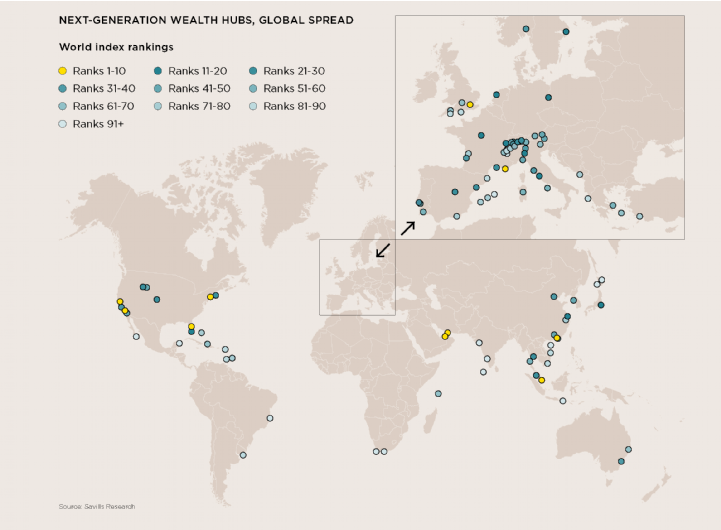
The index reveals that top markets span the globe, with legacy destinations, lifestyle hubs and traditional second home markets all featuring in the top 30. What distinguishes the leading markets is how they balance the four pillars of business and governance, taxation, wealth clusters and lifestyle.
The Americas dominate the index given the wealth creation ecosystems and concentration of HNWIs. New York, Miami, San Francisco and Los Angeles all rank within the global top five, reflecting the continued strength of the region's wealth proposition.
Markets across Europe, the Middle East and Africa (EMEA) account for more than half of the global top 30, reflecting the region's ability to combine wealth preservation, connectivity and lifestyle. The region's breadth, spanning global financial centres, coastal markets and Alpine destinations, remains one of its defining advantages.
Asia Pacific's strongest performers combine wealth creation, connectivity and favourable wealth management environments. Singapore and Hong Kong lead the region, while emerging destinations are broadening the range of options available to globally mobile capital.
New sources of wealth
Globally, new wealth is being built at speed through entrepreneurship, technology and AI ventures. This is creating a new generation of wealth holders with different priorities and investment behaviours. Forbes reported a record number of self-made billionaires aged 39 and under in 2025, many of whom generated their fortunes through AI-led businesses. This illustrates a new trend in wealth generation and accumulation, which differs from inheritance or more traditional career progression.
As wealth is created faster and by a more diverse group of individuals, wealth management strategies must become equally dynamic. Portfolios are increasingly extending beyond equities and property into private markets, digital assets and alternative stores of value. Luxury collectables, once seen purely as lifestyle purchases, are often viewed through an investment lens, as portfolios evolve and expand to include new and different assets such as luxury handbags. For advisers, the challenge remains protecting wealth across generations, and understanding how newly created wealth is generated and deployed in a global and changeable investment landscape
Outlook - challenges and opportunities
The destinations best positioned for future success will be those that balance wealth creation, preservation, connectivity and quality of life
The Great Wealth Transfer is reshaping who holds wealth and where it is ultimately deployed. The highest performing destinations in Savills Next Generation Wealth Hubs Index combine business opportunity, connectivity, wealth preservation and quality of life.
The continued strength of established global centres such as New York, London and Singapore, alongside influential lifestyle hubs including Miami, Monaco and select Alpine and coastal markets. Despite their differences, the strongest-performing locations offer the infrastructure, stability, connectivity and a compelling residential proposition.
Political and fiscal policy will continue to influence location decisions. Tax, residency and regulatory changes are increasing complex, while supply constraints across many prime markets continue to support long-term capital values. At the same time, dynamic economies including India, Vietnam, Saudi Arabia and the United Arab Emirates are attracting attention through strong wealth creation, infrastructure investment and improving lifestyle credentials.
For residential markets, changing preferences may prove just as important as changing wealth dynamics. Lifestyle, wellness, flexibility, privacy, education, and global connectivity are becoming important drivers of residential demand and location decisions. This shift is supporting demand for branded residences, wellness-led developments, and turnkey properties that allow globally mobile buyers to move seamlessly between homes and jurisdictions. Beyond capital preservation, prime real estate provides flexibility, supports succession planning and creates access to global networks, education systems and business ecosystems.
As wealth moves across borders and generations, capital is likely to become more selective. Scarce, turnkey and highly serviced assets in markets that combine legal stability, lifestyle quality, privacy and long-term liquidity are likely to remain most resilient. At the same time, portfolios are becoming more diversified, with real estate considered alongside private markets, technology, hospitality and operating businesses. This does not diminish the importance of property, but it does change the way it is assessed. Residential real estate must now deliver more than capital preservation alone. It must support how wealth holders and their families want to live, work, travel, connect and plan for the future.
Read the articles within Savills Spotlight on Wealth Trends below.
.png)
.png)
.png)