By the end of September, 673 farms and blocks of bare land over 50 acres had been publicly marketed, the fewest in four years and 12.5% fewer than last year. The number of launches is lower in every country and region but the average property size is higher, meaning the total marketed acreage is down by only 6.2%.
Across Great Britain, fewer properties were launched during Q1 to Q3 this year compared with the same period of 2025.
In the East of England and the West Midlands, the acreage marketed was 13.9% and 3.2% higher, respectively, than in Q1 to Q3 2025. Meanwhile in the South West, the number of properties was 15.7% lower, and the total farmland area fell by 24.7% for the same period. The larger farm size and higher supply of farmland in the East of England suggest an underlying trend: more arable land is being marketed, as the graph below demonstrates.
As the agricultural transition continues in England and begins in Scotland and Wales, farmers are being prompted to review how they farm in an era of reduced public financial support. But for the arable sector this coincides with, and contributes to, a period of lower profitability. Although margins have improved since July, oilseed rape margins remain significantly below the levels achievable before the war in Ukraine. Wheat margins had also been under pressure for a year, reflecting high stocks and elevated fertiliser prices following the US–Iran war. As disruption to Black Sea exports intensified over the summer, wheat prices rose. More recently, however, prices have begun to ease due to repeated ceasefire proposals covering fuel or food exports and strong harvest results elsewhere in the world.
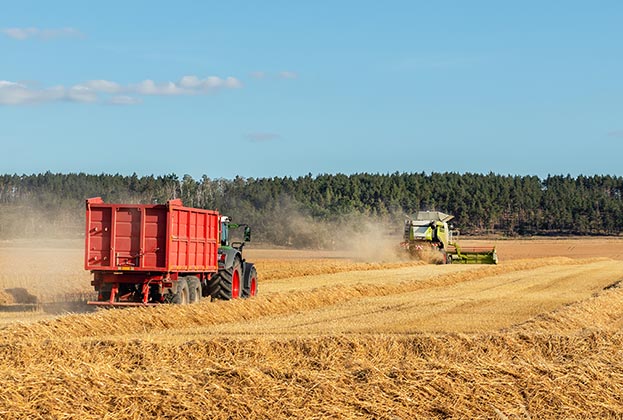
Our data on farm machinery dispersal sales clearly shows the transition is affecting farmers’ decisions. The number of sales rose 76% to 185 during Q1 to Q3 this year compared with the same period of 2015, including a higher proportion of sales from arable units (44% compared with 36% last year). Retirement (37%) and changes in farming policy/machinery (38%) explain most farm machinery dispersal sales in the arable sector, and both are higher than last year (29% and 35%, respectively). Machinery sales do not necessarily lead to farm sales – some farming businesses will continue under a revised operating model, although some farms will be sold, increasing the availability of commercial arable units on the market.
Farmland values
Average values have softened, but when priced sensibly to build and maintain momentum, farms are selling well. Successful purchasers are tending to be farmers, and some areas, especially Scotland and central England, have a shortage of good-quality, larger arable and mixed units. More properties are selling in lots; this is likely because local farmers each focus on the lots most relevant to them.
According to the Savills Farmland Value Survey, the overall average land value for Great Britain has fallen by 2.2% so far this year.
Values in Scotland are up 0.4%, driven by a demand for arable land, while average arable values in Wales rose 1.1% – but all livestock grades fell in value, reducing the overall average land value by 1.7%.
By the end of Q3, average farmland values in England had fallen by 2.6%, with the North of England and Midlands proving more resilient than southern regions. Values were unchanged in the North of England, while the Midlands showed a mixed performance across land types.
Downward pressure on arable values was most evident in the East and South of England. In the East of England, buyers have more choice, which has concentrated demand on best-in-class farms with scale and strong infrastructure, while interest in lower-quality units has weakened; overall values fell by 5.8%. Values also softened consistently across the South West and South East, with arable land among the most affected. Overall declines were 2.9% in the South West and 3.9% in the South East.
Agricultural challenges and a flight to quality
At the beginning of the year, our Farmland Market Spotlight forecast that values would remain stable in 2026. Soon afterwards, however, the outbreak of war between the US and Iran disrupted fuel and fertiliser supplies, pushing up input costs and squeezing farm margins. These challenging agricultural economics, combined with the slower development of nature markets, have weakened demand for farmland and contributed to the price falls seen so far this year. Against this backdrop, buyers are placing a premium on quality infrastructure and secure access to water and there have been cases of sale prices achieving considerably more than the average value.
Looking ahead, investment in assets such as improved livestock accommodation, on-farm reservoirs, greenhouses, polytunnels and farm shops should become easier as the new National Planning Policy Framework gives substantial weight to benefits such as domestic food production and supports the sustainable growth of rural businesses.
Further information
Contact Andrew Teanby or Alex Lawson